What happened to the ValidSpliceMut website?
Content described by our publication (link) is now hosted by the ClinVar database at the US National Library of Medicine. Our database entries are now available either through direct ClinVar variant searches (link), or by gene or source tissue (link), or by searching all of our laboratory submissions (link):
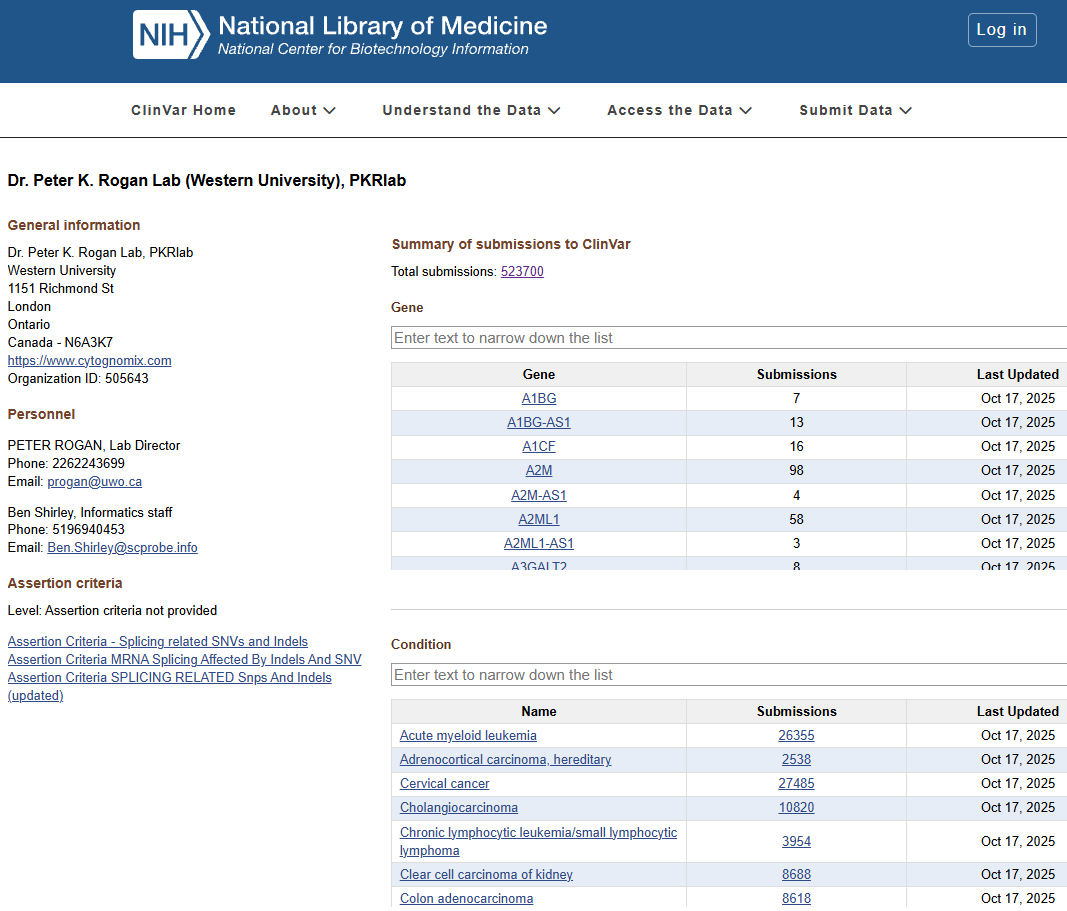
ClinVar recently released guidelines for submission of gene variants with functional evidence in support of pathogenicity designations. This is the type of data that ValidSpliceMut provided. It is our view that the medical genetics community is well served by variant discovery and interpretation data being cohosted by ClinVar, since together these results better assist in genome analysis of partial of complete genomes of patients with clinical genetic findings.
We are presenting a paper at the 2026 American Society of Human Genetics meeting on Thursday, October 22 at 4:15 PM describing the database transition of ValidSpliceMut to ClinVar. The accepted abstract is available as a news item on this website (link). It describes the protocol used to submit variants to ClinVar, which resulted in removal of certain invalid variants from our original website.
The original ValidSpliceMut website can also be reconstructed from Zenodo repositories:
-
The entire dataset is published as a SQL dump in Zenodo:
Validated natural and cryptic mRNA splicing mutations (tab delimited). Source data computed by the Shannon pipeline and Veridical, previously displayed on ValidSpliceMut: https://doi.org/10.5281/zenodo.3377025 updated: https://zenodo.org/records/3522192
- Instructions to create a web-based API that can be utilized to programmatically query variants in our Validated Splicing Mutations dataset. It was built in accordance with the GA4GH Beacon v1.0.0 specification.
- Instructions to reconstruct website which services as a local interface to the web-based API, allowing users to manually search for a variant, by gene name or genome coordinate range. It automatically queries the API, and formats the results of the search, if any.
- Ancillary software developed for Expression data processing, Histogram input generation and Bash Script Generating Programs for the Integrated Genome Viewer.